Finding Your Local Idaho Tap Water Source and Annual Quality Report
Your tap-water report can be hard to find when a city has several providers, service areas, or water sources. The first step is matching your address to the right water system; the next is locating and reading that system’s annual Consumer Confidence Report. Here’s how to do both, what the report can tell you, and when you may need information beyond it.
Identify the water system that serves your address
The name of the city or town on your mailing address does not necessarily identify your water provider. A home within city limits might be served by a city utility, while a nearby property may receive water from a separate district or private company. Some systems also serve customers outside the municipal boundary.
Start with your water bill if you receive one. Look for the utility or provider name, which may appear near the account number or payment information. A landlord, property manager, or homeowners association may receive the bill instead. If you do not have access to it, ask who supplies the water and whether the property has a direct connection to a public system or a shared private well.
You can also check property records, a closing document, or a service agreement. These documents may identify the provider, but treat them as clues rather than proof: service arrangements can change, and the name on an old document may no longer be current.
Use an address, not just a city name
When you contact a provider, give the full service address, including the unit number if there is one. Ask:
- Which water system supplies this property?
- Is the address within a particular pressure zone or service area?
- Does the system use one source, or can the source vary?
- Which annual water quality report applies to this address?
- Is the property connected to public water, a shared system, or an individual well?
This matters when a utility operates multiple wells or service areas. A provider may publish one report for the full system, or separate reports for areas with different water sources. The utility can tell you which applies to your service address.
A neighboring household can be a useful starting point, but do not assume it has the same water. A road, subdivision, or boundary may separate service areas. Even when two homes have the same provider, their plumbing and water-use patterns can affect the water at the tap.
For a more detailed look at how to confirm a provider in a particular area, see Boise Tap Water Service: Determining If Veolia or the City Serves You. For other parts of Idaho, the same principle applies: verify the provider for the exact property rather than relying on its city name.
Check whether the home uses a private well
A home supplied by an individual private well generally does not receive a public water system’s annual Consumer Confidence Report. The well owner is responsible for arranging appropriate testing and maintenance. Shared wells and small systems can have different arrangements, so ask the owner or operator what applies.
A real estate listing, old well record, or a visible wellhead may help clarify the setup, but it is best to verify directly. If the property has a private well, start with Who Is Responsible for Idaho Private Well Water Safety? and Idaho Private Well Testing: What to Test and How Often. Public-system report results do not establish the quality of a private well, even if the well is close to a municipal service area.
Find the annual Consumer Confidence Report
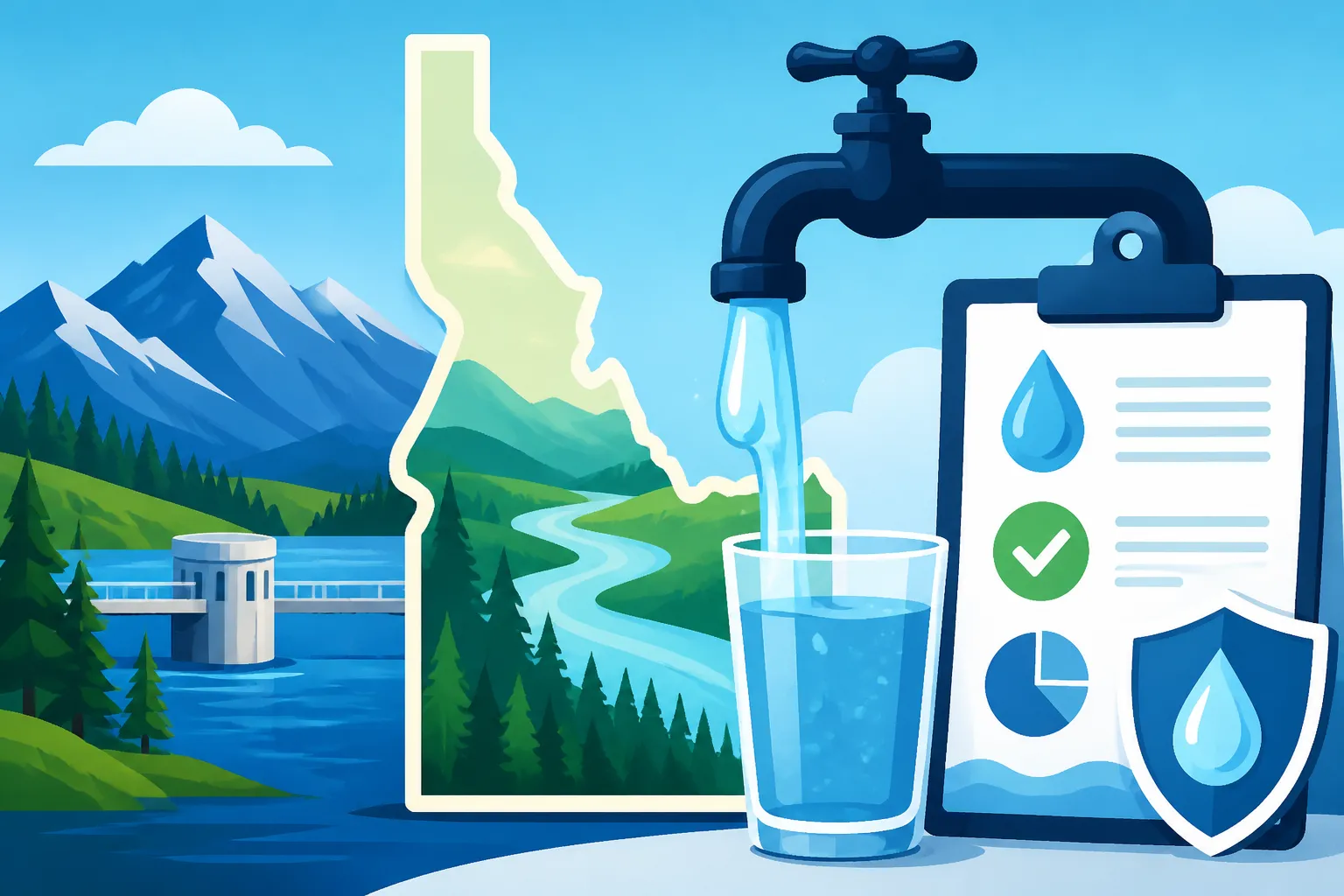
A Consumer Confidence Report, often shortened to CCR, is an annual drinking-water quality report for many community public water systems. It summarizes information about the system’s source water, monitoring results, detected contaminants, and any violations reported for the period covered. The report is sometimes called an annual water quality report or an annual drinking water report.
The report is not a universal Idaho report. Each system prepares or provides information for its own customers, so the provider you identified in the previous section is the best starting point.
Search the provider’s official website
Try searching the provider’s official website for phrases such as:
- Consumer Confidence Report
- annual water quality report
- drinking water report
- water quality
- CCR
Look for a report that names the system and shows the reporting period. The newest report may describe the previous calendar year, so a report dated for one year can contain results collected during the year before it. Check the report itself rather than assuming its title year and sampling year are identical.
A utility may place the document under Public Works, Water, Utilities, or Customer Information. If a search result leads to an old PDF, check whether a newer report is listed nearby. If you cannot find a current report, contact the provider through its official website and ask for the report that covers your service address.
Look through official Idaho drinking-water information
Idaho’s drinking-water information pages and state data tools can help you identify a public water system or locate monitoring information. These tools may use a system name or identification number rather than a familiar neighborhood name. The provider can confirm that you have the right record.
For a more detailed walkthrough, see How to Access Idaho Public Water Quality Reports Through City Portals and How Idaho Public Water Systems Use the Compliance Monitoring Data Portal. If you are in Boise, How to Access Boise City Water Quality Data on Drinking Water Watch covers a local route to public data.
A state data record and an annual report are related but not interchangeable. A monitoring database can include sample-level information, while a CCR is organized for customers and typically presents selected results with explanations. If figures appear different, check the dates, sample locations, units, and monitoring periods before concluding that the records conflict.
Ask for help if you are unsure
If a report is missing, difficult to interpret, or appears to cover a different part of the system, ask the provider to confirm:
- The formal name of the system serving your address.
- The reporting period covered by the document.
- Whether the report applies to your service zone.
- Whether a separate report is available for another source or part of the system.
- Where to find the underlying monitoring results.
For a small system, a report may not be posted in the same way as a larger city utility’s report. The provider or the appropriate state drinking-water office can explain how customers can obtain the applicable information. Use the official utility or agency website to find current contact details.
Find out where your tap water comes from
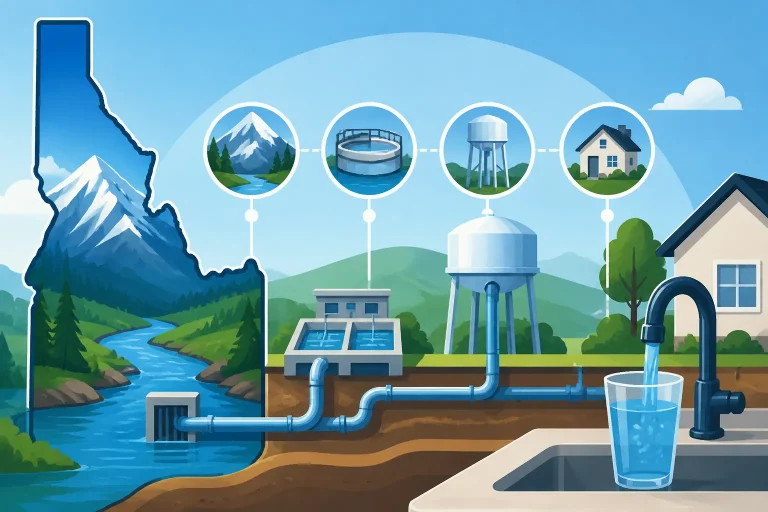
A report’s source-water section usually describes the source or sources used by the system. Idaho systems may draw water from groundwater, surface water, or a combination. Groundwater comes from wells that draw from underground aquifers. Surface water comes from sources such as rivers, reservoirs, or other surface supplies. The system’s treatment and monitoring approach depends in part on the source and the design of the supply.
A report might list one well, several wells, a surface-water source, or a source description that refers to an area or group of facilities. That description tells you about the system’s supply; it does not necessarily mean that every drop delivered to your home came from one particular source at all times.
Understand source names and service zones
A system may operate several wells or draw from more than one source. It may also blend water or change which sources are in use. In these cases, a report can combine results for the system or distinguish results by source, treatment plant, or service area.
Look for terms such as:
- Groundwater: water pumped from wells.
- Surface water: water drawn from rivers, lakes, reservoirs, or similar sources.
- Purchased water: water supplied by another public system.
- Source or well name: a location or facility that contributes to the supply.
- Treatment plant or service area: a part of the system where water may receive different treatment or come from different sources.
If a report lists several sources but does not explain which one serves your neighborhood, ask the provider. A general source description can be accurate for the system while still leaving out address-level details.
For background on how source type relates to treatment, see Surface Water vs Groundwater: How Source Shapes Idaho Tap Treatment. If a provider draws from a basalt aquifer, How Idaho Protects Drinking Water From Confined Basalt Aquifers explains one aspect of source protection in Idaho.
Source water is not the same as water at your faucet
A CCR describes monitoring and treatment at the public-system level. Once water enters a building, service lines, fixtures, plumbing materials, water age, and household use can affect what comes out of an individual tap. For example, a building’s plumbing can contribute metals even when the utility’s source water meets applicable requirements.
That is why a system-wide report should not be read as a test of every household faucet. If you are investigating a specific concern in your home, the report can provide context, but the next step may be a targeted test or inspection. Pinpointing Tap Water Problems: Municipal Main or Interior Plumbing? explains how to think through that distinction.
Read the report without getting lost in the numbers
The report’s tables can look technical, but a few headings help you understand what they show. Start with the reporting period and the name of the system. Then check the contaminant name, the result, the unit, the applicable standard or benchmark, and any note describing how or where samples were collected.
A simplified comparison can help orient you:
| Report item | What it generally tells you | What to check |
|---|---|---|
| Contaminant | The substance or indicator that was monitored | Whether it is a regulated contaminant, a treatment indicator, or another parameter |
| Result | A measured level or monitoring summary | The unit, sampling date or period, and whether it is an individual result or a range |
| MCL | The maximum contaminant level established for a regulated contaminant | Whether the result is compared with this limit and how the system calculated compliance |
| MCLG | A non-enforceable health goal set below or equal to the MCL | It is a goal, not the enforceable limit |
| Action level | A trigger used for certain rules, including lead and copper monitoring | It is not the same type of standard as an MCL |
| MRDL | A maximum residual disinfectant level | It applies to disinfectant levels, not to every contaminant |
| Violation or explanation | A reported compliance issue or other required notice | What happened, when, and whether the issue was resolved |
The table is a reading aid, not a substitute for the definitions and notes in the report. Terms and reporting formats can vary by contaminant and monitoring rule.
Check units before comparing results
Water results may be reported in units such as milligrams per liter, micrograms per liter, parts per million, or parts per billion. Some measurements use other units. Do not compare two numbers until you confirm that their units match.
For a basic explanation of common concentration units, see Understanding Parts per Million and Parts per Billion in Water. Keep the report’s original units beside any notes you make. A number that looks larger may simply be expressed in a smaller unit.
Also check whether the result is a single measurement, a range, an average, or a regulatory calculation based on multiple samples. The number of samples and the way a result is summarized can affect how it should be interpreted. If the report does not make that clear, ask the provider what the figure represents.
Distinguish standards, goals, and action levels
Several kinds of numbers may appear in a report, and they do not all mean the same thing.
A maximum contaminant level, or MCL, is an enforceable drinking-water standard for a regulated contaminant. A maximum contaminant level goal, or MCLG, is a health-based goal that is not itself the enforceable limit. A treatment technique may require a system to follow a specified process rather than meet a numeric limit in the same way. An action level can trigger particular requirements when results reach a specified level, but it is not an MCL.
These distinctions matter when a table displays a detection alongside a goal or threshold. A detection does not automatically mean the system violated a standard, and a result below a health goal is not the same thing as an MCL comparison. Review the report’s explanation and definitions, especially if the table includes multiple benchmarks.
For more detail, see MCL vs MCLG in Idaho Tap Reports: Understanding Safety Margins and Action Levels vs MCL Standards in Idaho Public Drinking Water.
Understand “detected,” “not detected,” and “violation”
A contaminant may be detected at a level below the applicable limit. A detection means the monitoring method found the contaminant at the reported level; it does not, by itself, establish that the water violates a standard or that a specific household faces a health risk.
“Not detected” generally means the contaminant was not found at or above the method’s reporting threshold in the samples described. It does not prove that the contaminant is impossible to detect under any conditions, or that every tap in the system was sampled. The report’s notes may explain the threshold and sampling scope. What Non-Detect Means on Your Idaho Consumer Confidence Report provides more detail.
A violation indicates that the system did not meet a particular drinking-water requirement. Read the accompanying explanation to find out which requirement was involved, what period it covered, and what corrective steps or notices were reported. Some violations concern monitoring, reporting, or treatment processes rather than a measured contaminant level above a standard. The word “violation” deserves attention, but its meaning depends on the specific rule and circumstances.
A report with no listed violations is useful information about the system’s reported compliance for that period. It does not mean every household faucet was tested, that no contaminants were detected, or that a plumbing issue cannot occur inside a building. For context, see Zero Violations on a Tap Report: What Clean Utility Records Mean.
Know what a CCR can and cannot tell you
An annual report is a summary of public-system monitoring and compliance information for a defined period. It is valuable for understanding the source, treatment, detected contaminants, and notices the system reports to customers. It is not a complete snapshot of water at every home on every day.
Sampling is limited to particular places and times
Public systems collect samples according to monitoring requirements and approved sampling plans. A sample represents a particular location and time, not every pipe, fixture, and tap served by the system. Some contaminants are monitored frequently; others are monitored on a different schedule. The report may summarize results collected over a period rather than give a daily record.
This means that a report can be accurate and still not answer every question about a specific household. It may not show what happened after a recent main break, a change in source operations, or a plumbing problem inside the home. For current operational information, check the provider’s notices and announcements as well as the annual report.
Building plumbing can change water at the tap
Water quality can be affected by the materials and condition of plumbing between the utility’s system and the faucet. A building’s service line, internal pipes, brass fixtures, and other plumbing components may influence water at a particular outlet. Water that has been sitting in pipes can also differ from water that has just moved through them.
Lead is an important example because it can enter water through plumbing materials even when the source water supplied by the utility meets its requirements. A CCR may report system-level lead and copper sampling results, but those results do not determine the lead level in every home. If you have a concern about an older home or a particular tap, consider testing that tap using an appropriate method. See Lab Testing Is the Only Reliable Way to Detect Tap Water Lead and Water Service Lines Explained: Utility Ownership vs. Homeowner Side.
A report also cannot identify every possible cause of a change in taste, odor, color, or cloudiness at a single faucet. Those changes can have different explanations, from plumbing conditions to maintenance work. If the change is sudden, persistent, or accompanied by an official notice, contact the provider through its official website and follow any instructions it issues.
A report is not a custom filter recommendation
The CCR can help you understand what a public system monitors and reports, but it is not a recommendation to install a particular treatment device. A home filter should be selected for a specific, documented need. Its certification and performance claim must match the contaminant and the intended use; different devices reduce different substances, and not every product treats every contaminant.
If you are considering treatment, first clarify the concern with the provider or a qualified testing professional. Compare any test result with the claims and certification of the exact device model. Do not assume that a general “water filter” label means a product reduces a particular contaminant. Public Tap Water Safety: Evaluating If Your Home Needs a Water Filter explains how to assess whether household treatment is appropriate.
What to do if the report raises a question
A report can prompt follow-up without necessarily indicating an emergency. Use the question to guide the next step rather than relying on a single number or a product advertisement.
- Confirm the system and service area. Make sure the report covers the provider and zone that serve your address.
- Check the reporting period. Find out which sampling dates the results represent and whether newer information is available.
- Read the notes and definitions. Look for units, sampling locations, benchmarks, and explanations of any detected result or violation.
- Ask the provider a focused question. For example: “Does this result apply to my service area?” or “Is there a more recent monitoring result?”
- Use a suitable test if the question is household-specific. A home test should be designed for the substance and sampling location you want to assess. For testing that requires laboratory analysis, ask a certified lab how to collect and submit the sample.
- Avoid treating a detection as a diagnosis. A test result needs to be interpreted in context, and health questions should go to a local health department or medical professional.
If the provider has issued an active advisory, follow the current instructions in that notice rather than relying on an annual report. A CCR may not reflect an event that occurred after the reporting period. Idaho Boil Water Advisories: Emergency Protocols and Tap Safety explains how advisory instructions differ from routine annual reporting.
If you are a renter or guest
Renters and short-term guests may not receive the utility bill or direct notices. Ask the landlord, property manager, or host for the provider name and current report. Confirm whether the building is on public water or a private/shared well.
If the property receives public water, the provider’s report may be available online even if the account is in someone else’s name. For questions about alerts, ask the property manager how notices are passed to residents and check the provider’s official website for current information. How Idaho Renters and Vacation Guests Can Receive Direct Water Alerts covers ways to think about notice access when you are not the account holder.
If you cannot tell whether the report is current
Compare the report date, the period it covers, and any notice on the provider’s website. An older report may remain online because reports are retained for reference; that does not make it the latest one. Ask the provider which report is current for your address and whether any more recent monitoring results or notices are available.
A database entry may be newer than a customer report, but the two may organize or summarize results differently. If the date or value appears inconsistent, ask the provider to explain the sampling period and calculation. Keep the system name and report title with your question so the provider can identify the record quickly.
Frequently Asked Questions
Does every Idaho home have an annual water quality report?
No. Annual Consumer Confidence Reports apply to many community public water systems. A home supplied by an individual private well generally does not receive a public-system CCR. Shared wells and other small systems may have different reporting arrangements, so confirm the setup with the owner or operator.
Does living in a city mean the city provides my water?
Not necessarily. A separate district or provider may serve the property, including homes within or near a city boundary. Check a bill or ask the provider to identify the system for your exact address.
What year does an annual report cover?
The report states its reporting period. A newly issued report may summarize monitoring from the preceding calendar year, so the title year and sampling year may differ. Check the dates inside the document and ask the provider if they are unclear.
Does a detection mean my tap water is unsafe?
Not by itself. A detection means monitoring found a substance at a reported level. Its significance depends on the contaminant, units, applicable standard or benchmark, sampling information, and the system’s compliance status. Ask the provider about the result, and direct health-effect questions to a local health department or medical professional.
Does a clean report prove my home’s plumbing is safe?
No. A system report summarizes monitoring for the public water system; it does not test every household tap. Plumbing materials and conditions can affect water inside a building. If you have a home-specific concern, consider an appropriate test or plumbing assessment.
Disclaimer
This article is for general informational purposes only and does not constitute professional advice. Laws, prices and regulations vary by location and change over time. Consult a qualified professional for guidance on your specific situation. Idaho Water Guide is not a government agency or water utility and is not affiliated with any public water system.