Idaho Water Systems: How to Trace Service From Source to Tap
Idaho Water Systems: How to Trace Service From Source to Tap
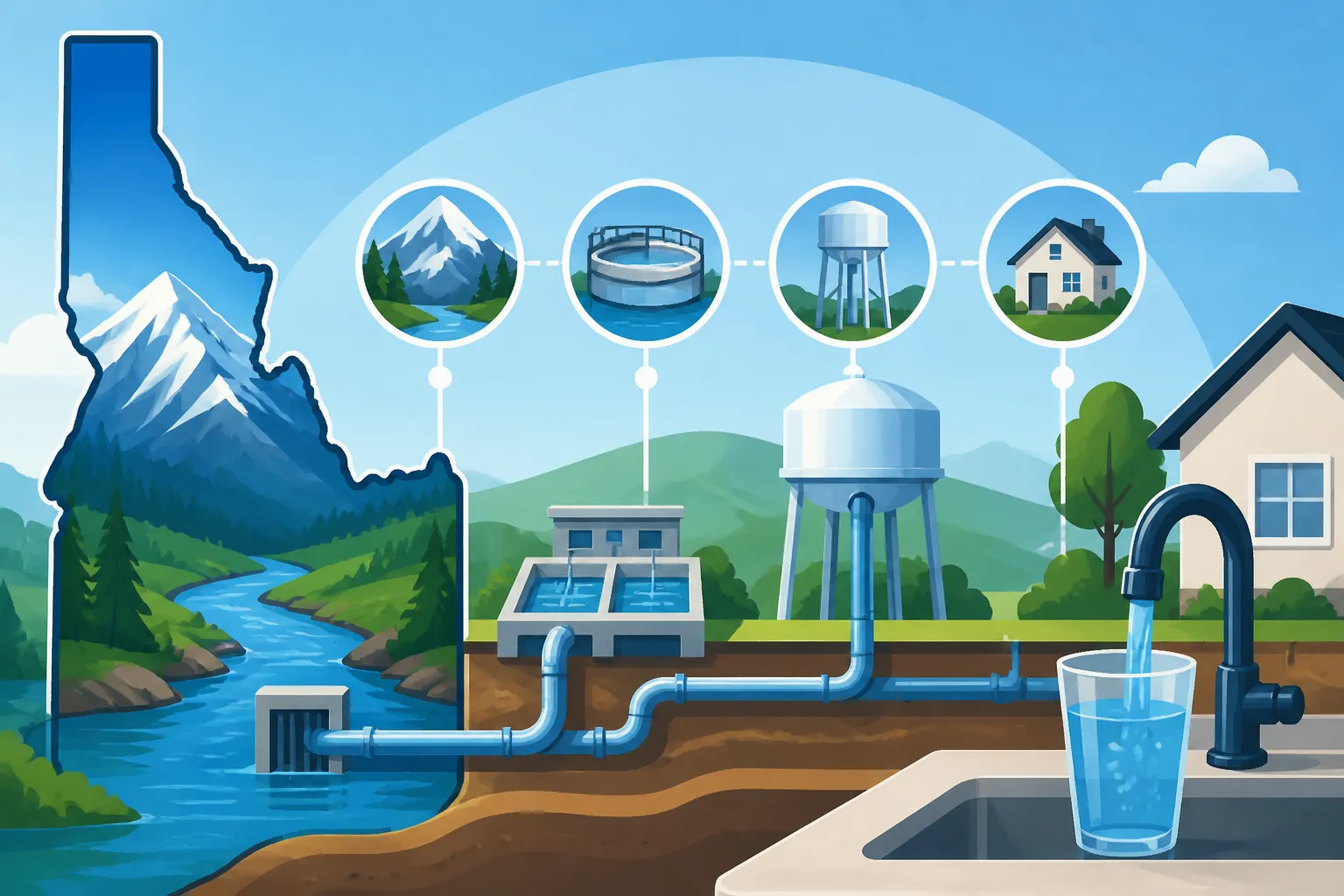
When a faucet problem appears, it can be hard to tell whether the cause is the water source, the public system, the service line, or plumbing inside the building. Tracing water from source to tap gives you a practical way to find the right records, ask useful questions, and narrow down where a concern may begin.
Start With the Address and the Water Provider
The first step is identifying which provider serves the property. A town or neighborhood name may not be enough: service boundaries can differ from postal addresses, and nearby homes may receive water from different providers. For a rental, shared building, or recently changed service arrangement, the person who receives the bill may not be the person who knows the system details.
Look at a recent water bill if one is available. It may name the provider, show a customer-service contact, or identify a service account. If you do not have a bill, ask the property owner or manager, check the provider information supplied with the property documents, or contact the likely provider through its official website and ask whether it serves the address. Do not assume that a nearby provider serves a property simply because its pipes or facilities are visible nearby.
Once you have the provider’s name, confirm the service relationship directly. Give the complete street address and, when relevant, the unit or building designation. Ask whether the property is connected to the provider’s drinking-water system, and whether another organization handles billing or service-line records. A billing company, property manager, or homeowners association may handle customer communication without operating the water system itself.
The provider is the useful starting point because it can help connect the address to system information: the water source, annual quality report, service-line records, and any notices affecting the area. It may also explain where the system’s responsibility ends and the property owner’s responsibility begins. Keep a note of the provider’s name and the department or contact channel that handles drinking water questions.
For a broader overview of how regulated systems relate to customers, see Guide to Idaho Public Drinking Water and Municipal Tap Safety. To look for an annual report associated with an address, Finding Your Local Idaho Tap Water Source and Annual Quality Report can help you understand what to search for and what the report is meant to cover.
If the property uses a private well rather than a provider’s public system, the path is different. A utility’s annual report and service-line inventory will not describe a private well’s water or household plumbing. Confirm which arrangement serves the building before using public-system records to answer a question about the tap.
Trace the Water’s Source and Treatment
After identifying the provider, ask where the system’s water comes from and how it is treated before entering the distribution network. A provider may use groundwater, surface water, or a combination. The source matters because it shapes what the provider monitors and the treatment steps it may use. It does not, by itself, tell you whether the water at a particular faucet has a problem.
Water-quality reports are a good place to begin. A report may describe the source, treatment processes, monitoring results, and any required notices or explanatory information. Read the report for the system that serves the address, not just a report for a nearby city or county. If the provider operates multiple areas, ask whether one report covers the property’s service zone or whether the system has separate information for different areas.
You can ask the provider questions that connect the source to the tap:
- What source or sources supply this address?
- Where can I find the current water-quality report for this service area?
- What treatment processes are used before the water enters the distribution network?
- Is the address in a particular pressure or service area that has separate source information?
- Are any current water-quality notices or service disruptions relevant to this address?
The purpose is not to interpret every technical result without context. It is to establish which source and system the report describes, and to get the provider’s explanation when a result or term is unclear. A detected substance in a report does not automatically explain a taste, odor, or plumbing concern at one home. Conversely, a report covering system monitoring does not necessarily describe conditions inside a home’s pipes.
For an explanation of how different source types can shape treatment, see Surface Water vs Groundwater: How Source Shapes Idaho Tap Treatment. For an overview of how Idaho DEQ’s role relates to public water systems, How Idaho DEQ Regulates and Monitors Community Water Systems can provide additional context.
A helpful distinction is the difference between source-water information and tap-water information. Source-water records concern water before or as it enters treatment. A consumer report generally presents information about the regulated system and its monitoring. A sample drawn from a household faucet can reflect additional factors, including building plumbing and how long water has been sitting in it. These records answer related questions, but they are not interchangeable.
If you cannot find the report, ask the provider for the report that applies to the address and the period it covers. Check that the report name and service-area description match the property. If the provider’s answer points you to a regional or shared system, ask which organization operates that system and who can explain the report’s results.
Follow the Route Through Treatment and Distribution
Once water has been treated, it travels through a distribution network before it reaches an individual property. This part of the route can include public mains and smaller connections. A provider may be able to explain the general path serving an address, but a household usually does not need a detailed engineering map to begin investigating a tap concern.
It helps to separate system-wide questions from property-specific ones. If a provider reports a planned repair, a water-quality notice, or a service interruption affecting an area, that points toward a network issue to ask about. If the concern is isolated to one building or one faucet, interior plumbing deserves attention too. These are clues for deciding whom to contact, not proof of where a problem started.
Ask the provider whether it knows of work, flushing, pressure changes, or notices relevant to the address. Describe what you observe, where it occurs, and when it began. A clear description can be more useful than a broad statement that “the water is bad.” For example, say whether the issue appears at one faucet or multiple taps, and whether it affects cold water, hot water, or both. Avoid assuming that an unusual appearance or smell identifies a specific contaminant.
The distinction between the public system and household plumbing is important because each may have different records and responsible parties. A provider can explain system conditions and its side of the connection. A property owner or qualified plumbing professional can investigate private plumbing components. The provider’s role and the property owner’s role should be confirmed for the specific property rather than inferred from a general diagram.
If a concern appears across multiple nearby properties, tell the provider that as part of the report. If it appears only within one building, note whether multiple fixtures show the same change. Those patterns can help guide follow-up, but they are not substitutes for testing when testing is needed.
For more help separating public-main concerns from household plumbing concerns, see Pinpointing Tap Water Problems: Municipal Main or Interior Plumbing?. If the question is about pressure zones or how water is distributed through a network, How Municipal Water Systems Use Pressure Zones to Balance Supply explains why a provider may describe service areas rather than one simple route from a treatment facility to a tap.
Do not use a general map or a neighbor’s experience as conclusive evidence about a property’s supply. Neighborhood infrastructure can be connected in ways that are not obvious from street layout, and the provider is the best place to confirm the system serving the address. If the provider cannot answer a particular question, ask which organization or department keeps the relevant record.
Identify the Service Line and Its Ownership Split
The service line is the connection between the water system and a building. Its material and the point where ownership changes are important to understand, especially when asking about lead. The provider’s records may identify the material classification for the property, but the address-specific record is more useful than assumptions based on the home’s age or appearance.
The U.S. Environmental Protection Agency describes lead service lines as a key source of lead in drinking water when they are present in a water system. That is why it is worth checking the service-line information rather than relying only on a water-quality report or a visual impression of a pipe.
Idaho DEQ advises residents to Contact Your Water Provider and ask it to look up the service-line material classification for the property. When you contact the provider, ask it to check its service-line inventory and identify the material on both sides of the ownership split. Idaho DEQ says Material classifications are required for both the system- and customer-side when ownership is split.
The ownership split matters because the provider may maintain records for the system side while the property owner is responsible for the customer side, depending on the arrangement. Do not assume that one record describing part of the line describes the entire connection. Ask the provider to explain what each classification covers and whether any portion is unknown or needs further investigation.
The U.S. Environmental Protection Agency says the inventory must be publicly accessible, so check the utility’s publicly accessible service-line inventory using the property address. If the inventory does not identify the material, contact the utility or a licensed plumber. The U.S. Environmental Protection Agency’s guidance does not say renters are required to contact their landlord, but a renter may need to involve the landlord to arrange access for an inspection.
You can also inspect exposed pipe where it enters the home, but appearance alone may not settle the question. Pipe coatings, corrosion, paint, joints, or limited access can make visual identification uncertain. Do not cut, scrape, or disturb a pipe to try to identify it. If you cannot confidently identify a material, confirm it with the provider or a licensed plumber.
When you contact the provider, it can help to ask:
- Does the inventory include this exact address and unit?
- What material is recorded for the system side?
- What material is recorded for the customer side?
- Is any portion listed as unknown or needing verification?
- What does the provider recommend if the property record is incomplete?
- Who should arrange access if a physical inspection is needed?
Keep the answer with the property’s water records. If the provider gives a classification verbally, ask where it can be confirmed in writing or in the public inventory. If the address is absent from the inventory, make that clear and ask how the provider handles records that do not return an address match. A search result that displays no material is not the same as confirmation that every part of the line is made from a particular material.
For an explanation of the division between system and customer sides, see Water Service Lines Explained: Utility Ownership vs. Homeowner Side. If you are renting, How Idaho Renters Can Look Up Lead Pipes in Service Inventories discusses how to approach public records and access questions.
A service-line classification does not tell you the condition of every fixture or pipe inside the building. Nor does it necessarily answer whether water from a particular tap should be tested. Treat the inventory as one important piece of the route from source to tap, then ask the provider or a qualified professional what additional steps make sense for the property.
Understand What the Quality Report Can and Cannot Tell You
A water-quality report is useful, but it is not a direct test of every faucet in every building. It is intended to describe the system’s water-quality information and monitoring. The report’s results should be read alongside its explanation of the system, its service area, and any notes about monitoring or follow-up.
First, confirm that the report covers the correct provider and service area. A report for a nearby municipality may be irrelevant if the property is served by another system. If a provider manages different service areas or sources, ask which report applies. The provider can also clarify whether a result represents the system generally or a particular sampling location or period.
Then read the report’s definitions and notes before focusing on individual detections. The result, the units, the comparison value, and the report’s explanation all matter. A value cannot be interpreted responsibly by looking at the number alone. If a term or comparison is unclear, ask the provider to explain it in the context of the report and the system’s monitoring obligations.
A report can help you understand what the provider monitors and what results it reports, but it cannot establish the condition of every private pipe between the public connection and the faucet. It may not explain why one home has a different taste or appearance from another. It also cannot replace a properly collected household sample when a property-specific question requires testing.
Use the report as a starting document, not as a reason to skip address-specific questions. Match the report to the property, note any explanatory statements, and ask the provider about results that concern you. If the question is about the meaning of a detection or a particular reporting term, Reading Mineral Detections on an Idaho Annual Water Report can help with report interpretation. For a related explanation of report results, see Interpreting Detected Contaminants in Annual Tap Water Reports.
Be especially careful not to treat a detection as proof of harm or a non-detection as proof that no issue can occur anywhere in a home. Report data has a defined scope and sampling context. If you have a health question about a reported substance, ask a local health department or medical professional rather than trying to draw a medical conclusion from a report.
When the report does not answer a question, write down what is missing. Is the uncertainty about the source, treatment, monitoring location, service area, or household plumbing? Directing the question to the right part of the system often gets a clearer response than asking generally whether the water is safe.
Narrow Down a Tap Concern Without Guessing
A change in taste, odor, color, clarity, or pressure can have several possible explanations. The observation alone usually does not identify a cause. Start by recording what you notice and checking whether it is limited to one place or appears across the property.
A simple log can include:
- The faucet or fixture where the issue occurs
- Whether other taps show the same change
- Whether it occurs with cold water, hot water, or both
- Whether the change is constant or comes and goes
- When it began and whether it followed a known service interruption or building work
- Whether other residents or nearby properties report a similar issue
This information can help the provider or a plumber decide what to investigate. It does not replace a lab test when a test is appropriate, and it should not be used to identify a contaminant by smell, taste, or appearance. Some water concerns are not visible or detectable by taste.
If a concern occurs at one fixture, ask whether that fixture or its plumbing has been inspected. If it occurs throughout the building, compare observations at other taps and contact the provider to ask about conditions in the service area. If more than one property reports a similar change, include that information when contacting the provider. A broader pattern may help the provider check for a system-related issue.
For pressure concerns, tell the provider where and when pressure changes occur and ask whether there is a known service issue. A plumber can assess building-side components when the provider indicates the public system is operating normally or when the problem appears limited to the property. Avoid making repairs to public-side equipment or attempting to access infrastructure that belongs to the provider.
For questions involving possible lead, do not rely on water appearance, taste, or a service-line inspection alone. The U.S. Environmental Protection Agency identifies lead service lines as a key source of lead in drinking water when they are present in a water system, but the service line is not the only possible plumbing component to consider. Ask the provider about the service-line inventory and seek qualified guidance on whether property-specific sampling or plumbing evaluation is appropriate.
If a water notice or emergency instruction applies, follow the notice rather than relying on general troubleshooting advice. The instructions may specify whether water use should be restricted or what steps are needed. For Idaho-specific emergency guidance, Idaho Boil Water Advisories: Emergency Protocols and Tap Safety explains how to approach a boil advisory. A boil notice and a general taste or odor concern are different situations, so check the exact notice and its current status.
When the concern is not an emergency, the goal is to avoid jumping from an observation to a treatment purchase or a diagnosis. First establish which system serves the address, check relevant notices and records, and distinguish the public network from the building’s plumbing. Then ask the provider, a qualified plumber, or a certified laboratory which next step fits the actual question.
Build a Useful Source-to-Tap Record for the Property
A small, organized record can make future questions easier. Keep the provider’s name, a recent bill or service confirmation, the applicable water-quality report, service-line inventory information, and any relevant correspondence together. If you rent, keep copies of information you receive and note which records the property owner or manager may need to help access.
It is useful to record the date you checked the report or inventory, but avoid treating an old copy as a current answer. Reports and inventories may be updated, and a property’s service arrangements can change. When the question matters, return to the provider’s current information and confirm that the address still matches the record.
You can keep a short summary in a format like this:
| Part of the route | What to confirm | Who can help |
|---|---|---|
| Provider and service area | Which provider serves the address and which report applies | Water provider |
| Source and treatment | What source or sources supply the system and where treatment is described | Water provider and its quality report |
| Distribution | Whether the provider knows of work, notices, or service conditions affecting the area | Water provider |
| Service line | Recorded material on the system side and customer side, including any unknown classification | Water provider; licensed plumber for an inspection |
| Building plumbing | Whether the concern is limited to a fixture or appears throughout the property | Property owner, manager, or qualified plumber |
| Tap-specific question | Whether a sample or other evaluation is appropriate | Provider, certified laboratory, or qualified professional |
This table is a practical checklist, not a claim that each person has the same legal responsibility in every property arrangement. Responsibility can depend on the provider’s ownership boundary and the property’s setup. Ask the provider to explain the boundary that applies to the address, and consult a qualified professional when physical inspection or repair is needed.
A good record also separates confirmed facts from open questions. For example, note that the provider confirmed a service area, while the customer-side line material remains unknown. That prevents an unanswered question from being mistaken for a negative result. When speaking with a provider or plumber, bring the exact address and the observations you recorded so the follow-up can be specific.
The same method works when buying or moving into a property. Before relying on an old report, confirm the current provider and ask about the service-line inventory. If the records do not cover part of the route, ask what inspection or test would close the gap. A property’s water story is not complete merely because a report is available; the report, service line, and interior plumbing each answer different questions.
For a wider overview of the public-system records and roles that may be involved, see Why Idaho Utilities Keep Public Records of Water Sample Results. The practical objective is not to become an expert in every pipe or treatment process. It is to identify the right record holder, ask a clear question, and avoid treating an incomplete record as a complete answer.
Frequently Asked Questions
How do I find out which water provider serves my Idaho address?
Check a recent water bill or ask the property owner or manager. If that does not identify the provider, contact the likely provider through its official website and ask it to confirm service for the exact address.
Does a water-quality report describe the water at my kitchen faucet?
Not necessarily. A report describes system information and monitoring; it does not assess every private pipe or fixture inside a building. Ask the provider which service area the report covers and whether a household-specific test is appropriate for your question.
How can I check the service-line material for a property?
Search the utility’s publicly accessible service-line inventory by address, then contact the provider if the material is not identified or the result is unclear. Ask about both the system-side and customer-side classifications. A licensed plumber can help with an inspection, especially when access is needed.
Should I assume a water problem is coming from the public main?
No. The provider can check for system conditions, while a plumber can assess building-side plumbing. Note whether the concern appears at one tap, throughout the property, or at nearby properties, and share those details with the appropriate contact.
Sources
- U.S. Environmental Protection Agency — Service Line Inventory (checked November 14, 2026)
- Idaho Department of Environmental Quality — Information for the Public (checked November 14, 2026)
- Idaho Department of Environmental Quality — Service Line Inventories — Frequently Asked Questions (FAQ) (checked November 14, 2026)
- U.S. Environmental Protection Agency — LCRI Questions and Answers (checked November 14, 2026)
Disclaimer
This article is for general informational purposes only and does not constitute professional advice. Laws, prices and regulations vary by location and change over time. Consult a qualified professional for guidance on your specific situation. Idaho Water Guide is not a government agency or water utility and is not affiliated with any public water system.